If you’ve ever stood up after sitting for a while and felt your knees or hips “complain,” you’re not alone. For many adults—especially active seniors—joint stiffness can turn normal daily things (walking, stairs, gardening, travel, playing with kids) into something you have to “prepare for.”

That’s why more people are searching for type 2 collagen for joints and cartilage. Type II collagen is closely linked with cartilage—the smooth, cushion-like tissue that helps joints move comfortably. When cartilage health is under pressure (age, repetitive use, inactivity, extra weight, poor recovery), joints may start to feel less flexible or less “easy” day-to-day.
The good news: you don’t need a complicated supplement stack or a perfect lifestyle to support your joints. You need a repeatable daily routine—one that supports cartilage and joint comfort, plus the surrounding “support team” (bones, muscles, gut comfort, and daily energy). This article walks you through a practical, everyday approach you can actually stick to.
Want the full ingredient breakdown? See Ingredients & Science.
What is type II collagen, and why does cartilage care?
Collagen is a structural protein in the body. There are different types, but type II collagen is especially associated with cartilage, which sits at the ends of bones in joints (like knees, hips, shoulders).
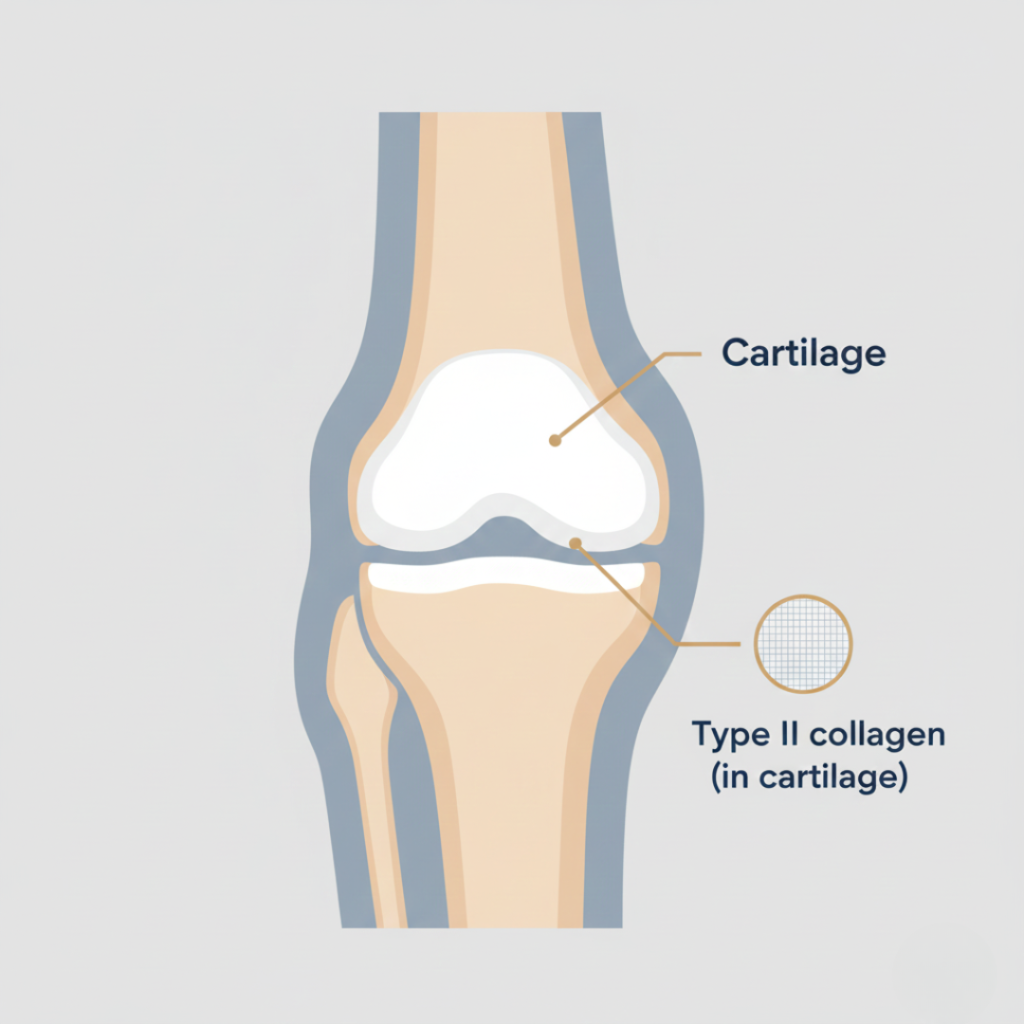
Think of cartilage like a smooth, protective layer that helps joints glide. Your body is constantly renewing tissues, but renewal can slow down with age, or be affected by diet, movement, stress, and recovery.
So when people talk about “supporting cartilage,” they’re often talking about supporting the daily building blocks and routine that helps your body maintain joint structure and comfortable movement.
For a plain-English overview of collagen and how it functions in the body, see this reference from Cleveland Clinic.
Why joints can feel stiffer as we get older (it’s not just “age”)
Stiffness is often a mix of small things adding up:
- Less daily movement (joints like gentle motion)
- Weaker supporting muscles (the joint gets more “load”)
- Long sitting hours (common for overworked adults)
- Poor recovery (sleep/stress)
- Digestive sensitivity (some people avoid foods/supplements that could help)
- Bone and mineral support gaps (calcium/vitamin D and other nutrients matter for the joint-bone system)
This is why the best approach usually isn’t “one magic ingredient.” It’s a simple routine that supports joints and cartilage plus the surrounding system.
Quick self-check: are your joints asking for more support?
You don’t need to “diagnose” yourself to know something feels off. Many adults relate to these everyday moments:
- Feeling stiff when you wake up, or after sitting
- Knees feeling “tired” after stairs
- Avoiding long walks because you don’t want the soreness later
- Needing more warm-up time before activity
- Feeling less steady or confident in movement
If these sound familiar, the goal isn’t to chase perfection. The goal is to build a routine that supports comfortable movement—consistently.
The most practical routine for cartilage and joints (what actually works long term)
1) Move your joints every day (gentle motion beats “weekend exercise”)
Cartilage and joints respond well to regular, low-impact movement. Think:
- 20–30 minutes of walking
- Light cycling
- Gentle stretching (especially hips, calves, hamstrings)
- “Micro-movement” breaks (2–3 minutes each hour if you sit a lot)
Tip: If you’re busy, don’t aim for “a workout.” Aim for movement snacks—small bits that add up.
2) Strengthen the muscles around the joint (this is huge)
Strong muscles reduce stress on joints. You don’t need a gym.
Simple options:
- Chair squats (or sit-to-stand)
- Step-ups (low step)
- Wall push-ups
- Glute bridges
- Resistance band rows
Start small. Do it 2–3 times per week. Consistency beats intensity.
3) Support bones and the joint-bone system
Joint comfort isn’t only cartilage. Bones and minerals matter too.
Many adults focus on joint products but ignore basics like:
- Calcium
- Vitamin D
- Magnesium
These are part of the wider “support team” for mobility as we age.
If you’re comparing options, this guide explains why US pricing can look higher for international delivery: Pricing transparency.
4) Don’t ignore gut comfort (especially if you’re sensitive)
If your stomach gets upset easily, you may avoid supplements or foods that could support you—then your routine becomes inconsistent.
A gut-friendly approach usually means:
- Keeping serving sizes reasonable
- Taking with meals (if needed)
- Choosing gentle formats
- Using routines that support gut comfort (like probiotics + prebiotic fiber) when appropriate
When your digestion is comfortable, sticking to a daily plan becomes much easier.
Probiotics aren’t one-size-fits-all—this NCCIH guide explains usefulness and safety in a balanced way.
5) Make it easy enough to do every day
This is the part people underestimate: the best routine is the one you will actually do.
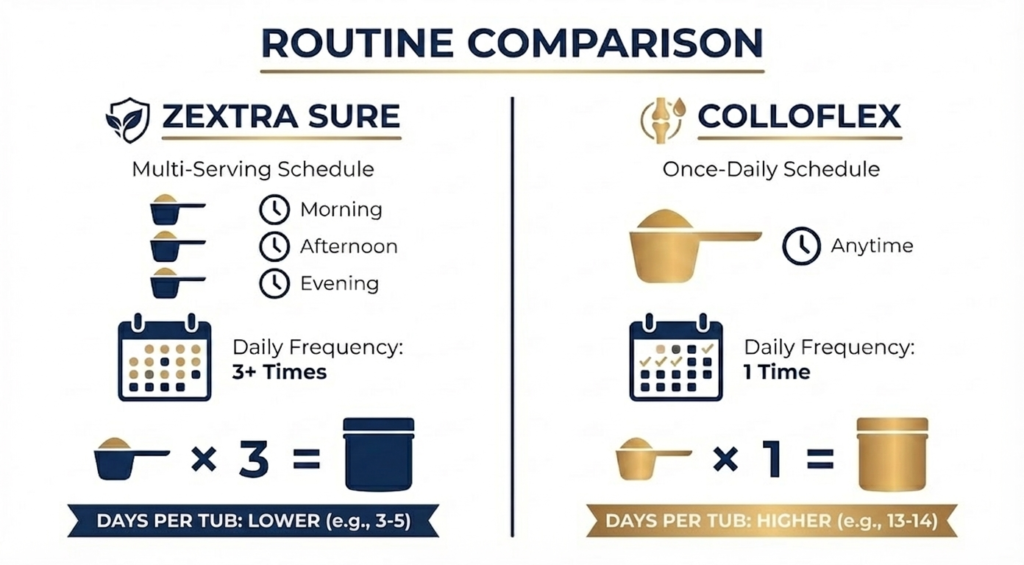
If you have to take multiple servings at different times, or manage several bottles, it often falls apart. Adults and seniors tend to do better with a simple once-daily habit—especially when life is busy.
Type 2 collagen for joints and cartilage: what to look for in a daily option
If you’re considering a daily product that includes type II collagen, here are practical things to check:
- Is it designed for a consistent daily routine?
- Does it include supportive nutrients beyond collagen (bone minerals, vitamin D, etc.)?
- Is it easy to take (taste, mixing, timing)?
- If you have a sensitive stomach, is it likely to be gentle?
- Can you realistically keep the routine for at least a few weeks?
A product only helps if it becomes part of your real life.
Why “once daily” matters for adults and seniors
A lot of people don’t quit because the product is “bad.” They quit because the routine is too complicated.
This is especially true for:
- Active seniors with joint stiffness
- Overworked adults who forget or skip
- Gut-sensitive wellness seekers who don’t want to gamble with discomfort
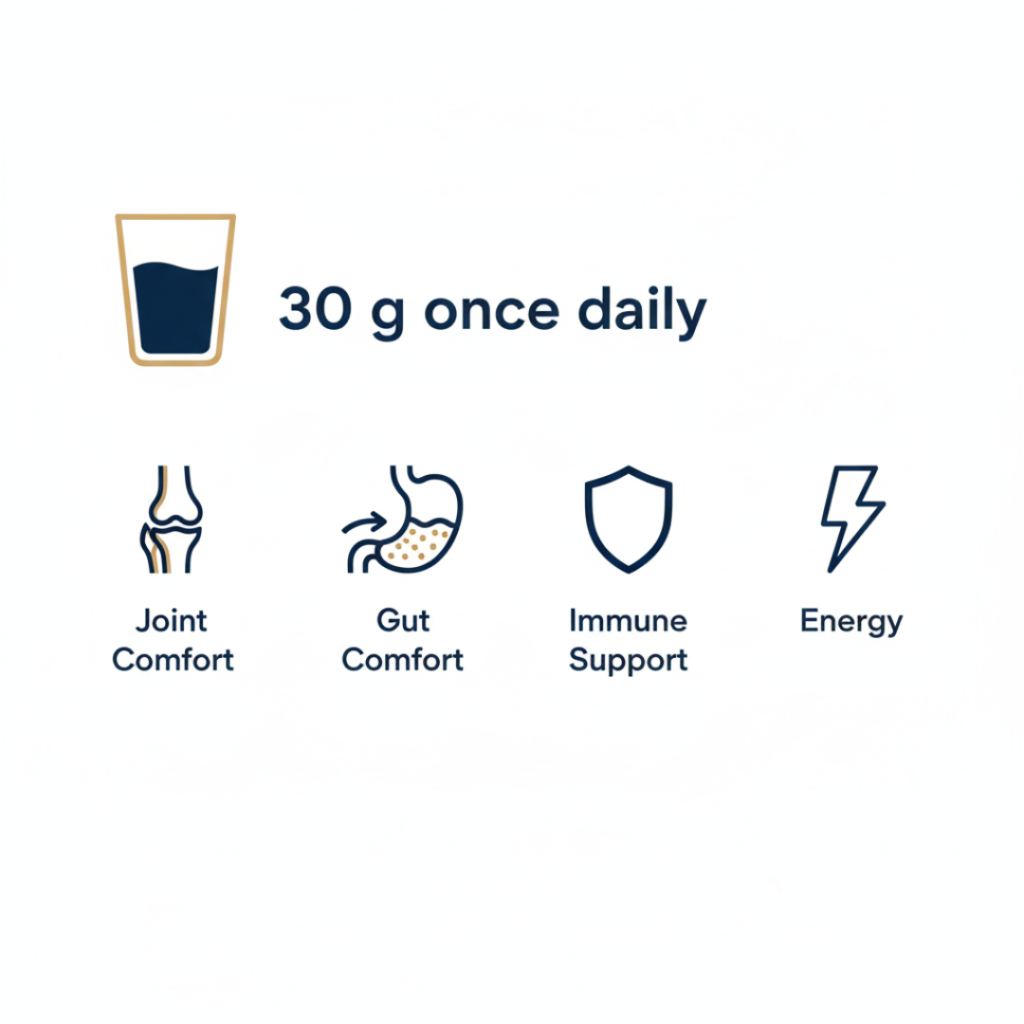
A once-daily approach works because it fits into real life:
- Breakfast routine
- After lunch
- Evening wind-down
When the routine is easy, it’s more likely to be consistent—which is what most people want in a wellness plan.
If you used Zextra Sure before, you’ll find a clear serving-size and routine comparison here: Zextra Sure vs ColloFlex.
Where ColloFlex fits (as part of a practical solution, not a “miracle”)
If you want an example of a once-daily approach built around this idea, ColloFlex is designed as a daily adult milk drink that combines:
- Type II collagen (cartilage-focused collagen type)
- IgG-rich bovine colostrum (often chosen for gut + immune routines)
- Probiotics + prebiotic fiber (inulin) (digestive comfort support)
- Calcium, magnesium, vitamin D3 (bone/joint-bone support)
- L-Carnitine + Coenzyme Q10 (energy metabolism support)
- Vitamin C, Vitamin E, and full B-complex (general wellness support)
- Plus a gentle milk/whey base in a vanilla-flavored drink
It’s positioned for adults and seniors who want one daily drink that supports multiple areas—rather than managing separate products.
How it’s taken: 3 scoops (30 g) mixed into about 180 ml lukewarm water, once daily, ideally with a meal.
This isn’t about replacing healthy habits. It’s about making the supportive part of your routine easier to stick to.
You can explore the full formula on our Ingredients & Science page, or view current packs on the Shop page.
A simple “7-day joint routine” you can start this week
If you want something actionable, try this:
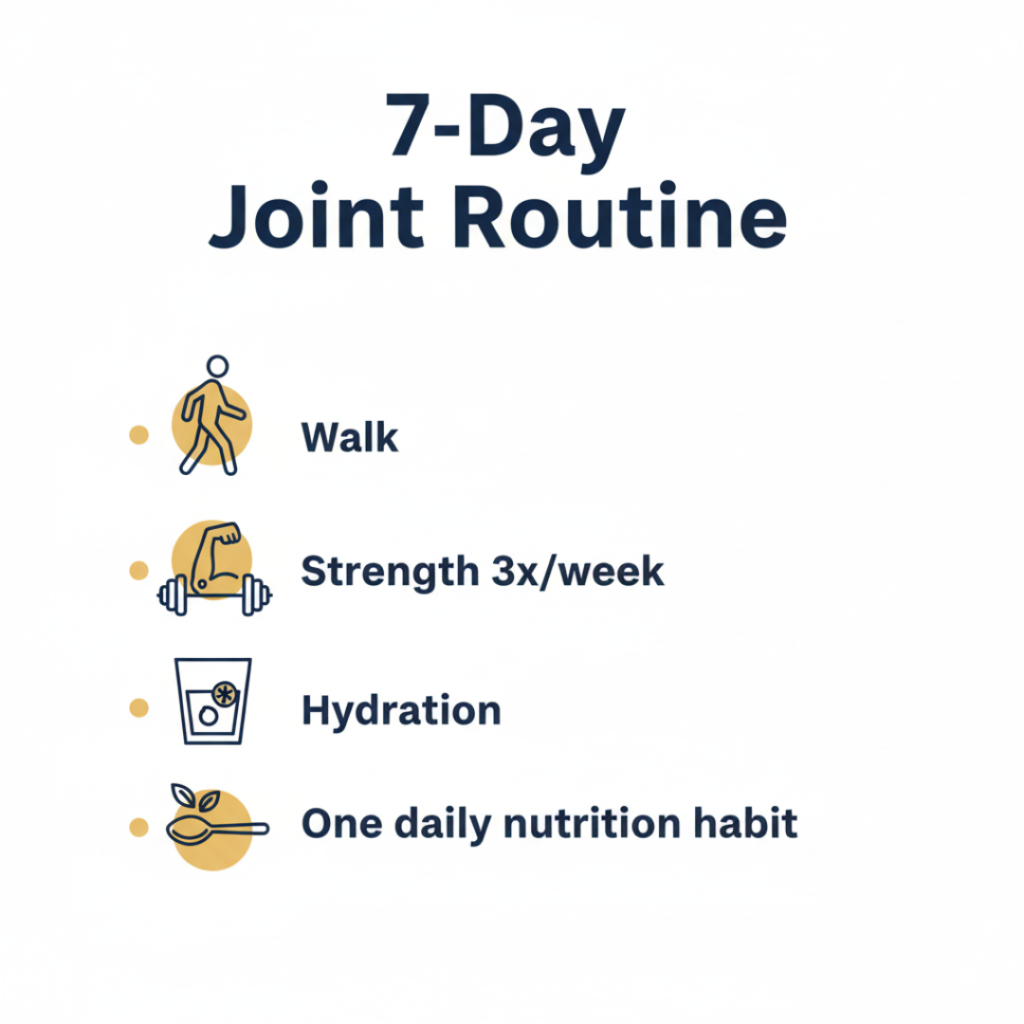
Daily (10–25 minutes total)
- Walk 10–20 minutes
- Mobility 3 minutes (hips + ankles)
- Hydrate (make it visible: bottle on desk)
- One daily nutrition habit (your chosen drink/supplement routine)
3 days per week (10 minutes)
- Sit-to-stand (3 sets of 8–12)
- Glute bridges (3 sets of 10)
- Band rows (3 sets of 10)
- Calf raises (2 sets of 12)
If you’re busy: cut everything in half, but don’t stop. Consistency is the win.
Common mistakes that slow progress (and how to avoid them)
“I only take support when I feel stiff”
That turns it into a reaction, not a routine. A daily approach tends to work better for long-term consistency.
“I try too much at once”
New routines fail when they feel like a new job. Start with 2–3 habits.
“I ignore gut comfort”
If something makes you uncomfortable, you won’t stick to it. Choose a gentle routine that suits you.
“I compare tub price instead of cost per day”
This is a big one. If one product is taken multiple times per day, it may finish much faster.
For example, ColloFlex is 400 g with a 30 g once-daily serving (~13.3 days per tub). That “how long it lasts” matters a lot when comparing value.
Who this routine is best for
Active seniors with joint stiffness
If your goal is to keep walking, moving, and enjoying daily life, a simple daily routine is often easier than a complicated stack.
Key message: Stay moving comfortably each day with one simple joint-nourishing routine.
Overworked adults wanting an all-in-one daily drink
If your days are long and you keep skipping “healthy habits,” a once-daily approach is more realistic.
Key message: One daily glass for joints, energy, gut and immune support.
Gut-sensitive wellness seekers
If many supplements upset your stomach, look for gentle formats and routines that consider gut comfort.
Key message: Gentle daily nutrition that supports digestion, immunity, and overall wellbeing.
Conclusion
If you’re looking into type 2 collagen for joints and cartilage, the smartest approach is to think bigger than one ingredient. Cartilage and joint comfort are supported by a combination of daily movement, strength, recovery, and a routine you can stick to—especially as an adult or senior.
Start with small, repeatable habits: walk daily, add simple strength work a few times per week, support the joint-bone system, and keep your routine gut-friendly. If a once-daily nutrition drink helps you stay consistent, it can be a practical part of your plan—because consistency is often what separates “trying something” from actually building a lifestyle routine.
If you want to learn more, explore your Ingredients & Science page and your Pricing transparency page so readers understand how to compare value using cost per day.